I arrived at La Paz airport, with many hitches, too complex to describe, at 5.35 am, almost the obligatory one hour before the departure of my flight to Oyuni in the South of Bolivia.
The check in was straightforward, I had two small bags as hand luggage instead of one that was allowed but no one said anything. I was reasonably asked if I was carrying a knife. I said no. I was asked if I was carrying shampoo. I said yes. That's ok then I was told.
Security screen over I went to a cafe and asked that they provide me with cup of tea and a sandwich as rapidly as was possible, as my flight to Oyuni was leaving in around 30 mins and I imagined it would be boarding.
The list of flights on the departures board displayed three possibilities for the status of the gate. Embarque, straight forward, people were getting on. Pre embarque, also straight forward I thought, the gate was not yet open just stay where you are. Cerrado. Tough luck , gate closed.
I watched Pre Embarque for a while. The waitresses who had flown around to organise my breakfast watched me and branded me unreliable because my time with them was not as rushed as I had declared but obviously very relaxed. With fifteen minutes to my flight time to go and Pre Embarque still showing on the board, I thought I would investigate and I headed towards the gate. Security was a breeze, throw your bags through the scanner, liquids and all, and collect at the other side.
There was one woman in security, and I was the only passenger. As four flights at least were listed for boarding at gate 7A I was surprised no one was around. I could see a very empty 7A. I asked which gate was for the Oyuni flight. A sole member of ground staff standing at 7A shouted to me that the Oyuni flight was leaving. I was the last passenger. Go go, she said, ushering me through the gate. Just go, plane is on the right.
I went; out on to the tarmac. I turned right. It was not yet light. Four Amazonas planes were on the ground and trucks were loading bags. No other ground staff were outside. No reassuring blue suited attendant standing at the wing tips to prevent a person from throwing themselves in to the blades of an engine. I climbed the stairs of the first aircraft. Oyuni I said confidently. Buenos Aires the indignant hostess said, as if she would commit her labour to anything less than an international flight. Go go, she commanded. Again I went, Argentina not this time being on my Solo Madonna list.
I descended the steps. Attempting to apply logic to the situation I chose the smallest Amazonas plane to board next, presuming the larger aircraft must all be international. A member of ground crew did appear at this point waving me outside the double yellow lines beyond which the waiting planes were lined. Oyuni I shouted to him. He was wearing ear muffs and just gesticulated to the right. I boarded the steps of the smallest plane. Oyuni I said with some desperation, presenting my ticket.
Sucre. We are going to Sucre a very smug hostess told me, but this is a privately chartered flight.
Sucre! The whole time I had been in Bolivia I had wanted to go to Sucre, but the persistently bad weather had meant planes were unable to land there. This was the closest I had come to achieving my dream of travel to the white city in the Andes. I wanted to ask her how this plane was going to land but she was not in the mood to chat. I was waved from the plane. The family or business commissioning the flight clearly not ready to accept a stranger in to their midst.
I believed at this point I had missed my flight. I was back on the tarmac with two planes to my right still available for selection when the most extraordinary thing happened. The member of ground staff with the ear muffs and very large gloves decided to treat me like a plane. He brought me towards him with very positive hand signals, turned me around, motioned for me to pass the next plane I would have ascended and with a flourish of relaxed arms directed me to the last standing plane. I ascended the steps and he performed a sort of salute raising one arm dramatically in the air.
Sucre I said, with very little optimism. Si, Buenas Dias Senora, please take your seat, we are just waiting for six more passengers and then we will be leaving. Is everything ok Senora? She enquired. Do you need a glass of water? I think you are having problems with the altitude, no? Don't worry, it is a common problem !

Journeys in South America
Friday, 7 February 2014

Wednesday, 5 February 2014
The Last Things That Juan Taught Me
Europeans have smaller hearts and lungs than Bolivians. Bolivians have the largest hearts in the whole of South America, that is why they can run, fish, swim, and work for dozens of hours in the oxygen starved air. Juan had no doubt at all it was why my lungs were burning and my head was spinning as we made our ascent towards our lunch which would be served at 4,000 metres.
He told me not to worry, I was doing well, most people he brought to the Island did not follow him on the track they simply ate by the port. If I in my near asphyxiated state could have recalled the Spanish words for knowledge and choice I would have used them.

Juan was contented at the summit. Relaxed as he ate his free lunch of quinoa broth and lake trout. We had passed an archaeological site, but perhaps as compensation for my suffering he wandered a little away from his guided tour script, beyond the boundaries of the palace built by the subjugated Aymara at the direction of the Incas to tell me the difference between Aymara and Europeans.

It is simple he said, Europeans want to see everything and yet they see nothing at all. They do not see the earth. They do not give thanks. The Aymara believe the world has three levels, sky, which contains the stars and the sun and the moon. The world of the present , the world in which we live , and the world beneath us, the world of Mother Earth.
Europeans do not see spirits he told me. They do not know that every mountain, tree and flower has a spirit that must be blessed. Every village has a spirit protector. His own village Huatajata was protected by the spirit within a mountain. The spirit was Incan Pata and the village was blessed because every man woman and child within the village took offerings to the spirit every August. The offerings were purchased by the people of the village from the Mercado de Hechiceria, the market of sorcery and witches in La Paz. The offerings which could be figurines of llamas, pumas, fish, or condors, ( the four elements in Aymaran culture, earth, fire, water and air), were purchased, presented, and burned on the mountain. Without offerings life would not carry on, the blessings of the spirit would be withdrawn.
I presume I was looking suitably amazed at this point when he went on to astound me. We combine all this with Catholicism, he casually said. Catholicism in Bolivia is very different to Catholicism in Europe. We worship God and Wirajocha. We have effectively two religions. At school we are taught the bible and taught about God. At home it is the duty of our father to teach us about the natural law. We as catholics are permitted to worship Wirajocha, the God, whereas protestants, they are not permitted to do this, their church does not allow it, he concluded matter of factly.
Juan was an educated man. His father was a teacher. Juan could speak English perfectly and had studied for five years in the University of La Paz. His faith in Wirajocha and in God was absolute. I did not consider him naive or misguided. The opposite, in his presence I felt like a lesser being.
The feeling of intruding on other lives continued as Juan marched me around the Island. The people here were just too far removed from modern life. I took photographs, but do not be fooled by the images. The life presented seems one of husbandry and simpleness, when in reality I am persuaded it has a strength and profundity within it most of us never achieve.


Things I Learned On Tuesday ( Part 2)
The idea of my Tuesday outing was to travel to Copacabana on the edge of Lake Titicaca,

take a boat to the Isla del Sol, circumnavigating the Isla de la Luna, eat lunch at an outpost restaurant on a high promontory at the summit of Isla del Sol and head back by boat to Copacabana. Once there I was to pay homage to the black virgin of the lake by visiting her carved statue, housed in the impressively white rendered domed cathedral, which stands unembarrassed amongst a crowd of unfinished, red brick box houses, in the centre of the town.
I found out that every house in Bolivia remains unfinished, not because of poverty but because of taxes. An unfinished house is tax free. A place of celebration neighbours flock to as soon as the roof goes on, carrying bouquets of flowers that are strapped to the unrendered walls.
I was told as soon as La Virgen Morena del Lago was installed on the adobe altar of the cathedral centuries ago, the miracles began. The first in 1583, the last three years ago, when a mineworker trapped in a landfall in a mine in Potosi was brought out alive. The only survivor among 17 fatalities, the only miner with a family who had travelled to Copacabana to ask mercy of the Virgen.
The most fundamentally pleased thing that I learned on my Tuesday tour was that even if a plan is altered, that alteration need not lead to disappointment. We could not take a boat from the lake shore at Copacabana, as the boat was small and the wind strong. We had to travel by road to a position more proximate to Isla del Sol where the straits would be narrower and the crossing more secure.
The road we were directed to ran through a forest of eucalyptus trees to a place of reeds and water. The high track gave us a view of the gentle shore, the basin of reeds and tethered boats. I surrendered and almost laughed out loud, when I thought Bolivia had exhausted its offering of beauty it showered me with more.


take a boat to the Isla del Sol, circumnavigating the Isla de la Luna, eat lunch at an outpost restaurant on a high promontory at the summit of Isla del Sol and head back by boat to Copacabana. Once there I was to pay homage to the black virgin of the lake by visiting her carved statue, housed in the impressively white rendered domed cathedral, which stands unembarrassed amongst a crowd of unfinished, red brick box houses, in the centre of the town.
I found out that every house in Bolivia remains unfinished, not because of poverty but because of taxes. An unfinished house is tax free. A place of celebration neighbours flock to as soon as the roof goes on, carrying bouquets of flowers that are strapped to the unrendered walls.
I was told as soon as La Virgen Morena del Lago was installed on the adobe altar of the cathedral centuries ago, the miracles began. The first in 1583, the last three years ago, when a mineworker trapped in a landfall in a mine in Potosi was brought out alive. The only survivor among 17 fatalities, the only miner with a family who had travelled to Copacabana to ask mercy of the Virgen.
The most fundamentally pleased thing that I learned on my Tuesday tour was that even if a plan is altered, that alteration need not lead to disappointment. We could not take a boat from the lake shore at Copacabana, as the boat was small and the wind strong. We had to travel by road to a position more proximate to Isla del Sol where the straits would be narrower and the crossing more secure.
The road we were directed to ran through a forest of eucalyptus trees to a place of reeds and water. The high track gave us a view of the gentle shore, the basin of reeds and tethered boats. I surrendered and almost laughed out loud, when I thought Bolivia had exhausted its offering of beauty it showered me with more.
The territory I was driven through was a valley of rich land. In this valley there was no need for land redistribution that was a necessity in other poorer parts of Bolivia. Here campesinos divided the valley, each family owning their own portion of the land. There were no title deeds. Title was memory, everyone knew to whom the land belonged. Trade in land was possible by exchange but strangers or foreigners would never have access to the valley Juan assured me of that. Lack of title was a protection, a guarantee as to the identity of those who would be allowed in.
Things I Learned On Tuesday ( Part 1)
Sometimes to charge a camera overnight and make sure the battery indicator is flashing full is not enough. Certainly not in Bolivia on a trip beyond the Altiplano to lake Titicaca. Every second the eye blinks a photo is framed. The loss of another perfect image in the instantaneous moment a digital camera takes to readjust itself to take another shot becomes wildly irritating. Everything is to be photographed here, and yet nothing of the engulfing overwhelming beauty can really be conveyed in a collection of megapixels, regardless of the numeric scale.

The road between El Estrecha de Tequina and Copacabana on Lake Titicaca has been ashphalted from 1999. Before that it was a rough track passable by jeep and before that it was a route for only campesinos walking sure footedly on land that they knew, leading loaded donkeys from the straits of Tequina to Copacabana in the hope of selling their fish or the produce of their fields. The road cuts in to an expanse of mountain softened by vegetation that is precisely the colour of the back of a leaf of sage.
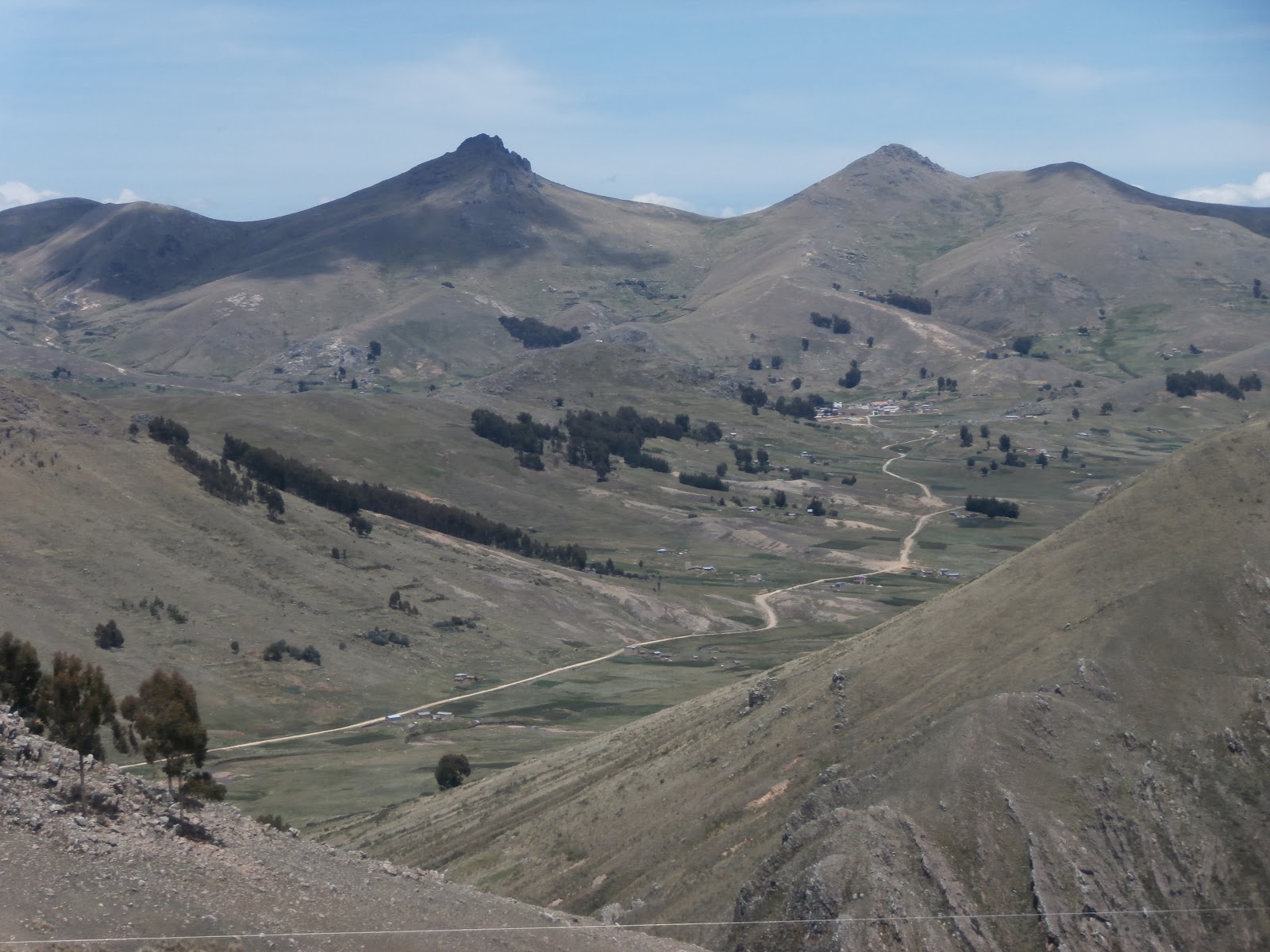
The announcements and proclamations made about Lake Titicaca are absolutely true. It is not like any other lake. It is a place of mystic power. The highest navigable lake in the world. It sparkles crystalline. Unpolluted on the Bolivian side unlike the shores in Peru. It is a place so light filled, one can understand why the Aymara believe the Sun was born here, and the Incas believed it was the birth place of civilisation.

The most sobering thing I learned on my Tuesday outing was that in some locations tourism has no place. We were obliged to go to El Estrecha de Tequina to take a ferry across a corner of the lake to pick up the road to Copacabana, but this pueblo was not a place for strangers. Outsiders were immediate voyeurs of a life that did not need them. The campesinos in Tequina honour the land, they live from it, living a life so far removed from the 21st century of the rest of us that a momentary stop in their town brought home another truth. This world is not now a small place reduced by telecommunications to a thimble, it is still a vast earth of differing cultures so complete in themselves that to step in without invitation is an intrusion, an insult, not a beneficent act.


The road between El Estrecha de Tequina and Copacabana on Lake Titicaca has been ashphalted from 1999. Before that it was a rough track passable by jeep and before that it was a route for only campesinos walking sure footedly on land that they knew, leading loaded donkeys from the straits of Tequina to Copacabana in the hope of selling their fish or the produce of their fields. The road cuts in to an expanse of mountain softened by vegetation that is precisely the colour of the back of a leaf of sage.
The announcements and proclamations made about Lake Titicaca are absolutely true. It is not like any other lake. It is a place of mystic power. The highest navigable lake in the world. It sparkles crystalline. Unpolluted on the Bolivian side unlike the shores in Peru. It is a place so light filled, one can understand why the Aymara believe the Sun was born here, and the Incas believed it was the birth place of civilisation.
The Aymara are subsistence farmers, they depend on the land. The deluge of recent rain has uprooted crops placing their valued self sufficiency in peril. I arrived on the day land grants were being provided as compensation. These grants were given by a government run by an indigenous president, raised on the land within a family of campesinos. Perhaps that is why the grants were given, and perhaps that is why they were accepted.
Jorge and Juan
I wanted to go to Lake Titicaca. The whole idea of Solo Madonna is to open up the world. Make good contacts, find the best and most informed guides who will be for every solo traveller a flag bearer, a way in to an existence that could be imagined but never previously participated in.
Who would a girl choose to guide her but Victor and Jorge, both Aymara. Juan contemplative, serious, born and raised in Huatajaja by the lake. Jorge a professional driver, light hearted, particularly about bends and white lines, which Madonna would not be safe in their hands.


Who would a girl choose to guide her but Victor and Jorge, both Aymara. Juan contemplative, serious, born and raised in Huatajaja by the lake. Jorge a professional driver, light hearted, particularly about bends and white lines, which Madonna would not be safe in their hands.
Particularly when they know refreshment stops such as this, serving the very best tea. Anis, grown, hand picked, boiled in to a plumping stew of a brew and served here.
Bowler Hats
They are everywhere. Worn by women of the Aymara and the Chechua. They are called Cholas in Bolivia but they are in reality Bowler hats first worn in Bolivia in the 1920's by English railway workers and copied ever since. Butch Cassidy even had one, although his would not have the significance of those worn by the power house indigenous women. These women are real commercialistas, stern to speak to and almost impossible to photograph. They are likely to break the camera with a glare and are best photographed cautiously from a distance, unless they invite you in.


They are the redoubtable matriarchs of the family as this grandchild's obedient upward stare goes some way to demonstrating.
The positioning of the Chola on a woman's head indicates if a woman is married or single. Worn to the right the woman is unapproachable by men outside of her family. To the left and she can be courted. If an indigenous woman takes off her hat and hands it to a man, she is engaged.

Indigenous woman have been seen at the front of many a political parade standing down the army and the police. Consider the culture of Pachamama, the most powerful deliver of life, abundance, rain, presented in female form, and understand the force these women have in Bolivian society. Not only are they through hours and decades of hard sales work, a real economic force, sporting lavish satin clothes and jewellery any Inca would be proud of, they are also revered.

Sometimes although commercially intrusive, approaching strangers in a darkened museum and asking for cash, they are simply abrasively and boldly sweet.

These women work really hard. They can be seen for up to fifteen hours on the streets selling anything, from hand made textiles to biros, to beans. They gradually accumulate wealth. The bowler hats signify where they stand in their society. The tallest hat signifying the greatest wealth, the most powerful caste.
The positioning of the Chola on a woman's head indicates if a woman is married or single. Worn to the right the woman is unapproachable by men outside of her family. To the left and she can be courted. If an indigenous woman takes off her hat and hands it to a man, she is engaged.
Indigenous woman have been seen at the front of many a political parade standing down the army and the police. Consider the culture of Pachamama, the most powerful deliver of life, abundance, rain, presented in female form, and understand the force these women have in Bolivian society. Not only are they through hours and decades of hard sales work, a real economic force, sporting lavish satin clothes and jewellery any Inca would be proud of, they are also revered.
Sometimes although commercially intrusive, approaching strangers in a darkened museum and asking for cash, they are simply abrasively and boldly sweet.
Monday, 3 February 2014
A Walk Around Tiwanaku
I was dreading the part in the museum. I hate guided tours. I prefer to fly around history absorbing the dramatically interesting parts and allowing the remaining facts and exhibits to hold others in front of glass display cases while I skip on. Fortunately therefore for me,as Victor pointed out,the museum at Tiwanaku provides the best example of corruption in Bolivia. A house was built to hold the precious excavated exhibits and only three months in to its lifetime it was struck by a deluge that caused the ceilings of many ill built rooms to collapse. Regrettably before going to the archaeological site itself we could only spend time in one room.
Inside was a 7metre high Pachamama, or Earth Mother. Women are sacred in Bolivia. They are honoured as the head of every family. They hold the power and provide the life and sustenance of every family unit. They are also evident at the head of every political parade. Even if occasionally on the phone!


One should not in reality touch the stones but Victor in full flow with his passion for historical facts did not notice as I slumped upon it and felt the heat of the ancient Aymara rush in to my blood. I will either be blessed or cursed, but if what happened next is anything to go by, my life post stone touching is likely to unfold in a very pleasant way.

The beautiful Brazilian poet Guillhermes Turri Frazzatto who had slept the whole way on the bus began to talk to me about his poetry. Incredibly while we were still mid tour, and not yet advised about the relevance of the gate of the sun, he produced his i phone and began to read to me from his latest works. There is something about guttural and lyrical portuguese thrown out across the stillness of a sunlit Altiplano that is captivating, particularly when every third word is ' amor '.
Guillherme trailed me around the temples and then even though I was almost fainting in the heat and overwhelmed by the intensity of the light he handed me his i phone and ask that I read his portuguese words for myself. ' You can understand Spanish he told me, you will understand; you have the special quality that is needed to understand my words'.
He had no idea that every God of the Aymara, los dioses, were walking with me, stirred by the sudden and unusual activity upon their sacred and sacrificial stone.
Inside was a 7metre high Pachamama, or Earth Mother. Women are sacred in Bolivia. They are honoured as the head of every family. They hold the power and provide the life and sustenance of every family unit. They are also evident at the head of every political parade. Even if occasionally on the phone!
The smaller statue of Pachamama, ( seen above), stands at the edge of one of the sacrificial sites. The site is visited every January by Evo Morales. It is here he is announced to be the political leader of the indigenous peoples of Bolivia. At this statue erected in the time of power of the Aymara he declares his nation to be a nation of plurinacionales and watches while a sacrifice, presumably of a Llama is made on the sacrificial stone several metres away. A stone I rested upon to support myself in the thin altiplano air as the intense sun shining at almost 5000 metres threatened to overwhelm me.
The beautiful Brazilian poet Guillhermes Turri Frazzatto who had slept the whole way on the bus began to talk to me about his poetry. Incredibly while we were still mid tour, and not yet advised about the relevance of the gate of the sun, he produced his i phone and began to read to me from his latest works. There is something about guttural and lyrical portuguese thrown out across the stillness of a sunlit Altiplano that is captivating, particularly when every third word is ' amor '.
Guillherme trailed me around the temples and then even though I was almost fainting in the heat and overwhelmed by the intensity of the light he handed me his i phone and ask that I read his portuguese words for myself. ' You can understand Spanish he told me, you will understand; you have the special quality that is needed to understand my words'.
He had no idea that every God of the Aymara, los dioses, were walking with me, stirred by the sudden and unusual activity upon their sacred and sacrificial stone.
Subscribe to:
Posts (Atom)